


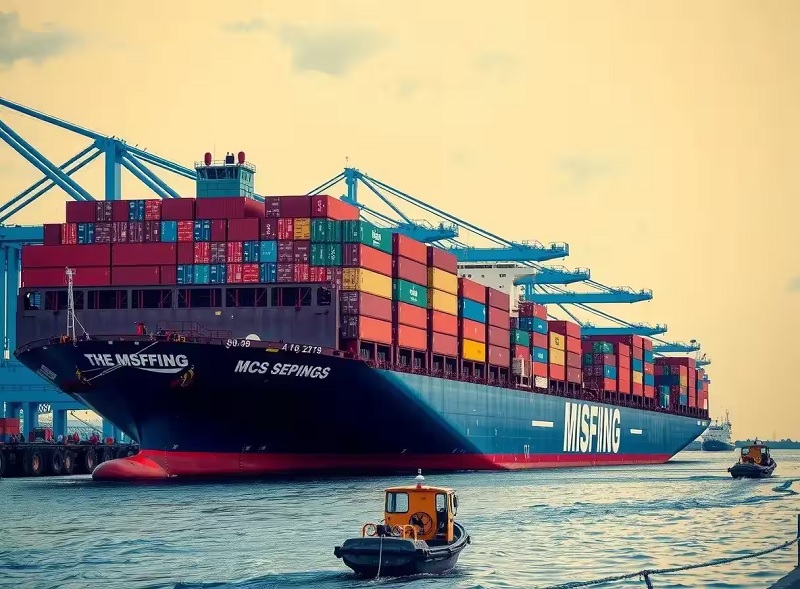
We live in a world that operates on the assumption of seamless global movement. When a manufacturer in Ohio needs industrial aluminum, a refinery in Texas requires crude oil, or a food processing plant in Iowa secures bulk grain, their primary concern is typically the spot price of the commodity itself. Yet behind every raw material transaction lies a massive, highly volatile logistics machine that dictates whether a trade is economically viable. Freight and shipping rates are not merely a downstream operational expense; they are the invisible hand that dictates global commodity flows, determines geographic winners and losers, and frequently triggers inflationary waves across the entire world economy.
When ocean freight rates surge, the economic geography of the planet shifts. A mine that was previously profitable to operate can suddenly become entirely unviable because the cost of moving the ore across the ocean eclipses the market value of the metal. Understanding the complex relationship between maritime logistics and commodity pricing is essential for anyone looking to navigate the intricate webs of international trade, supply chain management, and macroeconomic forecasting.
The Symbiotic Relationship Between Commodities and Cargo
To understand how shipping rates influence commodities, one must first recognize the fundamental symbiotic relationship between the two. Commodities are raw or primary agricultural products that can be bought and sold, such as copper, iron ore, crude oil, wheat, and coal. By definition, they are bulky, heavy, and geographically concentrated. The places where commodities are extracted or grown are rarely the places where they are consumed.
This spatial mismatch creates an insatiable demand for maritime transport. Dry bulk carriers haul iron ore and grains, tankers move crude oil and refined petroleum products, and container ships transport manufactured goods and specialized inputs. Because shipping capacity is physically finite and cannot be scaled up overnight, freight rates fluctuate wildly based on supply and demand dynamics. When shipping costs spike, they do not just absorb corporate profit margins; they fundamentally alter the landed cost of the commodity, reshaping trade routes in real-time.
The Mechanics of Dry Bulk Shipping and Raw Materials
When analyzing industrial and agricultural commodities, the dry bulk shipping sector serves as the primary economic barometer. Ships in this sector are categorized by size—ranging from Handysize vessels up to massive Capesize carriers capable of hauling upwards of one hundred and eighty thousand metric tons of cargo.
The Capesize Economy and Iron Ore
Capesize vessels are the heavy lifters of the global steel industry, primarily moving iron ore and coking coal from mining hubs in Australia and Brazil to manufacturing powerhouses in Asia and Europe. Because these vessels cannot fit through the Panama or Suez canals, they must navigate around the major capes of the world, making their transit times lengthy and expensive.
When freight rates for Capesize vessels soar due to port congestion or sudden spikes in Chinese industrial demand, the landed cost of steel manufacturing increases globally. Steel mills are forced to absorb these costs or pass them down to automakers and construction firms. If shipping rates remain elevated for a sustained period, steel producers will actively seek out closer suppliers, temporarily severing long-standing trade partnerships in favor of regional proximity over raw market efficiency.
Agricultural Flows and Panamax Vessels
The story is similar in agricultural markets, where Panamax vessels dominate the movement of corn, soybeans, and wheat from the breadbelts of North and South America to global export destinations. Grain traders operate on razor-thin margins. A sudden doubling of ocean freight rates can instantly erase a trader’s profit on a cargo of Brazilian soybeans destined for European ports. In response, trading houses will rapidly pivot their sourcing strategies, shifting orders to regions with shorter nautical miles to minimize exposure to runaway shipping expenses.
Tanker Dynamics and Energy Arbitrage
The liquid bulk sector, comprising crude oil and product tankers, operates under a different set of logistical pressures, yet the impact of freight rates is even more dramatic. Energy commodities are uniquely sensitive to geopolitical events, and freight rates in the tanker market can experience exponential spikes during periods of international conflict or shifting trade embargoes.
The Geography of Energy Arbitrage
Energy traders constantly look for price differentials between geographic regions—a concept known as arbitrage. For example, if crude oil is trading at a lower price in the Middle East than it is in the United States, a trader will purchase the oil, book a Very Large Crude Carrier, and ship it across the ocean.
However, if tanker freight rates spike due to a sudden shortage of available hulls or new regulatory compliance costs, that price differential can vanish entirely. High freight rates act as an economic tariff on energy, locking crude oil and refined products into their domestic or regional markets. This can create localized gluts of supply in exporting nations while simultaneously driving up fuel and heating costs in importing nations, independent of the underlying commodity’s baseline production cost.
The Ripple Effect of Bottlenecks and Geopolitical Chokepoints
Maritime logistics is a delicate, highly synchronized global network. When a disruption occurs at a critical geopolitical chokepoint—such as the Strait of Malacca, the Bab el-Mandeb strait, or the Panama Canal—the impact cascades immediately through commodity markets.
When vessels are forced to reroute around the southern tip of Africa rather than utilizing the Suez Canal, transit times increase by weeks. This sudden expansion in journey duration effectively removes a significant percentage of the global active fleet from service, as ships are tied up at sea longer. The resulting artificial shortage of cargo capacity causes spot freight rates to skyrocket.
For commodity markets, this means that even if a grain harvest is bountiful or an oil field is pumping at maximum capacity, the inability to secure reasonably priced transport creates an artificial scarcity. Buyers panic-buy nearby inventories, driving up spot prices while commodities sit stranded in ports waiting for available tonnage.
Navigating Price Volatility Through Logistics Strategy
Because freight rates are notoriously volatile, sophisticated commodity producers, traders, and manufacturing procurement teams cannot afford to rely solely on the spot shipping market. Managing freight risk has become just as critical as hedging against the price of the underlying commodity itself.
Major industrial players utilize long-term Contracts of Affreightment and time charters to lock in predictable shipping costs over multi-year horizons. By securing dedicated vessel capacity, they insulate their supply chains from the wild price swings of the spot market. Conversely, smaller players who must rely entirely on spot rates find their profit margins entirely at the mercy of maritime supply and demand cycles.
Ultimately, freight and shipping rates are the structural pillars upon which global commerce rests. They determine whether resources flow freely across oceans or remain isolated at their point of origin. By recognizing that a commodity’s true cost is always a combination of its extraction value and its transport logistics, businesses and investors can better anticipate the hidden shifts that drive global trade.
Comments are closed.