


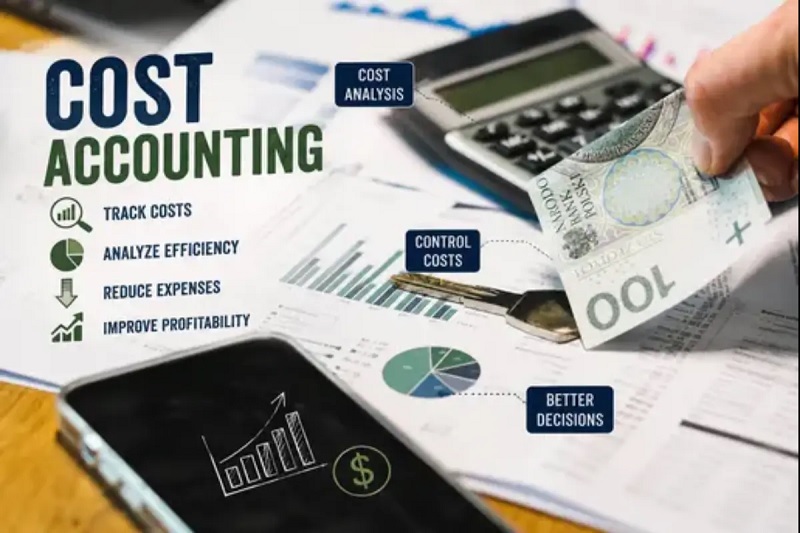
Many executives attempt to navigate their companies by looking exclusively in the rearview mirror. They rely heavily on standard financial accounting, waiting for month-end profit and loss statements, balance sheets, and cash flow reports to tell them whether they won or lost the quarter. While financial accounting is legally necessary for tax compliance and external stakeholders, it is fundamentally historical. It tells you that you lost money, but it rarely tells you exactly where, how, or why.
To proactively manage margins and scale a company sustainably, business leaders must turn to cost accounting. Unlike its financial counterpart, cost accounting is an internal, forward-looking discipline. It is the surgical breakdown of every expense associated with running a business, producing a good, or delivering a service. By transforming broad financial data into granular, actionable intelligence, cost accounting empowers leadership to stop guessing and start engineering true business profitability.
Moving Beyond the Illusion of Top-Line Revenue
In the modern business landscape, there is a dangerous obsession with top-line revenue. Companies frequently celebrate massive surges in sales volume, assuming that increased revenue automatically translates to increased profit. However, scaling a flawed operational model only scales the losses. If a business does not understand the underlying cost of acquiring and servicing a new customer, rapid growth can actually push the organization toward insolvency.
Cost accounting shatters the illusion of top-line vanity by forcing a relentless focus on the bottom line. It requires management to track exactly how much capital is consumed in the pursuit of revenue. By calculating the precise cost of goods sold and the operational friction required to deliver them, leaders can identify situations where the company is essentially paying its customers to do business with them. This shift in perspective ensures that every strategic growth initiative is modeled for actual profitability, not just raw volume.
Demystifying Overhead and Indirect Costs
One of the most persistent threats to business profitability is the mismanagement of indirect costs. Direct costs, such as the raw materials used in a product or the hourly wages of a frontline worker, are relatively easy to track. Overhead expenses, however, are notoriously difficult to assign accurately. Rent, administrative salaries, software subscriptions, insurance, and warehouse utilities all represent massive financial burdens that must be accounted for in the final pricing of a product.
The Danger of Traditional Cost Allocation
Historically, businesses have used simple, broad-brush methods to allocate overhead. They might take the total monthly warehouse rent and divide it evenly across all product lines, or allocate it based purely on the number of labor hours required for production. This “peanut butter spreading” approach is deeply flawed. It creates a distorted financial picture where low-maintenance products are artificially burdened with expenses they do not actually consume, while highly complex, resource-heavy products get a free ride.
The Activity-Based Costing Advantage
To correct this, modern cost accounting utilizes Activity-Based Costing (ABC). This methodology traces overhead expenses directly to the specific activities that drive them. If Product A requires intensive quality control testing and specialized machine setups, while Product B rolls off the line seamlessly, Activity-Based Costing ensures that Product A absorbs the financial weight of that extra labor and machinery use. This granular visibility prevents leaders from accidentally subsidizing their most inefficient operations and allows them to see the true, unvarnished margin of every item in their portfolio.
Identifying Profit Bleeders and Portfolio Pruning
Once a company implements precise cost allocation, the resulting data is often jarring. It is incredibly common for leadership to discover that their highest-grossing product or their most demanding legacy client is actually generating a net loss. Without cost accounting, these profit bleeders remain hidden, subsidized by the quiet, highly efficient products that are actually carrying the company.
With accurate cost data in hand, management can engage in strategic portfolio pruning. This involves evaluating every product, service tier, and customer segment based on its true net contribution margin. If a product line is fundamentally unprofitable, the business can take targeted action. They can raise the price, re-engineer the manufacturing process to strip out excess costs, or discontinue the offering entirely. Eliminating a high-revenue but negative-margin product shrinks the top line, but it immediately injects cash and efficiency back into the company’s bottom line.
The Power of Variance Analysis in Operations
Profitability is not just about setting the right prices; it is about maintaining strict control over operations. Cost accounting achieves this through the establishment of standard costs. A standard cost is a carefully calculated estimate of what a specific manufacturing process or service delivery should cost under normal, efficient conditions.
Once standard costs are established, the accounting team continuously runs variance analysis. This is the process of comparing the actual expenses incurred on the production floor against the expected standard costs. If there is a negative variance—meaning the company spent more than projected—leadership is immediately alerted.
Variances are typically broken down into specific categories, such as material price, material usage, and labor efficiency. If a negative variance is isolated to material usage, the operations manager knows to investigate the factory floor for excessive scrap or machine calibration issues. If the variance is in labor efficiency, it may indicate a need for better employee training or a flaw in the workflow. Variance analysis acts as an early warning system, allowing a business to course-correct operational inefficiencies in real-time before they can significantly erode quarterly profits.
Defending Margins Through Strategic Pricing
Pricing a product or service is one of the most critical decisions a business makes, yet many companies rely on instinct, competitor benchmarking, or arbitrary markups. Pricing based on what the market will bear is only effective if you explicitly know your internal financial floor.
Cost accounting provides the mathematical foundation for strategic pricing models. By clearly delineating fixed costs from variable costs, management can calculate the exact break-even point for every product line. Knowing the break-even point is critical during economic downturns or aggressive sales negotiations. When a major client demands a volume discount, a sales director armed with accurate cost accounting data knows exactly how far they can drop the price without slipping into negative margins. This prevents the panicked, uninformed discounting that routinely destroys corporate profitability.
Optimizing Make-or-Buy and Capital Decisions
As a business scales, it inevitably faces critical capacity and infrastructure decisions. Should the company invest in heavy machinery to manufacture a new component in-house, or should they outsource the production to a third-party vendor? Should they hire a full-time logistics fleet or utilize a third-party logistics provider?
Cost accounting provides the framework for these complex make-or-buy decisions. It forces management to look beyond the initial vendor quotes and analyze the total cost of ownership. This includes factoring in the opportunity cost of tying up working capital in heavy machinery, the carrying cost of raw inventory, and the hidden administrative burden of managing an internal team. By mathematically comparing the internal cost structure against the external vendor pricing, leadership can deploy their capital efficiently, maintaining high operational agility while protecting their profit margins.
A business that operates without robust cost accounting is essentially flying blind, reacting to financial reality only after the damage has been done. By embracing this discipline, a company transforms its raw data into a competitive weapon. It allows leadership to eliminate hidden waste, price their offerings with uncompromising confidence, and scale their operations based on mathematical certainty rather than blind ambition. In the relentless pursuit of business growth, top-line revenue may capture the headlines, but it is the precision of cost accounting that ultimately secures the profit.
Comments are closed.